

The winter season is upon us, which mean cold days are ahead. Even if you don’t take a winter break, sometimes it is nice to just relax on a snowy day. That’s why having some fun snow coloring pages ready to go is a great idea.

Snow Day Coloring Pages
Coloring was always a favorite activity of mine. I remember coloring for hours with my mom when I was younger. That’s why seasonal coloring pages are one of my favorite go-to activities for our kids.
The act of coloring works on so many motor skills, as well as identification of different colors for your little ones. Many older kids enjoy coloring too, so don’t leave them out! Try using different mediums with your older kids, such as pastels or watercolors.
Our Winter Activities MEGA Pack comes with 4 different levels of winter coloring sheets, as well as, colorable playdough mats and emergent readers too! So grab some white paper, turn on the printer and get started!

But before you start working on these Winter seasonal coloring pages, let’s learn a little more about the science of snow! You can find my snow research resources here and here.
The Science of Snow: The Facts
I have never loved cold weather, but there’s something so magical about snow. Looking out the window to see fresh fallen snow brings such a smile to my face and a flood of childhood memories to mind.
Growing up in Oklahoma, I rarely saw snow, which made it that much more magical when it filled our yard. But what made it fall in some parts of the country (or even state) more than others?
- Much like the “hairs” on a polar bear, snow is, in fact, not white! It merely appears white because visible light is white. Color is the reflection of what we see bouncing back at us, versus what is absorbed, by an object, however, snow reflects the majority of visible light, thus giving it the appearance of white.
- Not all snow appears white. You might recall seeing different hues of blue-ish tints in snow. This is typically seen in deeper snow and is because the light is being scattered and/or absorbing more than one color, which gives it a blue hue. If you’ve ever looked down a deep ravine of snow, you’ll notice that the further down you can see, the blue-r and darker it becomes. This is why!
- Red snow? The environment plays a part in colored snow too. If you have ever lived or traveled where there is significant snowfall, you may have come across snow that is red in color. Depending on where you are, the red snow, or Watermelon snow, is often found in higher elevations during the summer months due to a water fresh algae containing a bright red pigment. But if you ever get to Antarctica, Blood Falls in Taylor Glacier, has a deep red color due to saltwater leaking from deep below that produces iron, which oxidizes when it has atmospheric contact, and results in a bright red waterfall.
- Air particles color the snow too. Dust and soot that often fly through air land on the snow and can form its own layer. As more snow falls, the “dust layers” are pushed down. However, they will reappear and be brought to the surface as the layers of snow particles melt. This is why the higher a pile of snow is in a parking lot is, the darker it will become over time. The dirt is simply being brought to the surface as the snow melts away.
Classification and Physical Properties of Snow
Have you ever heard a skier mention, “fresh powder”? This is a type of snow that is light and fluffy, much like a powdery substance and in stark contrast to a hard-packed snow. But what makes snow fall hard or soft? It starts in the atmosphere!
For instance, if the conditions are windy, the ice crystals are tossed around, causing them to be broken into smaller pieces, thus producing a thicker, more densely packed snow.
If you live in a region that gets a lot of snowfall, throughout the winter you might notice that the characteristics of the snow changes, especially if it’s a highly trafficked area. This is due to the melting that occurs during daytime hours, which change the shape, size, and texture of the individual grains.

Snow Types
Speaking of grains, did you know the layers of snow are measured in part by grains? Yep! The grains are described by different characteristics of the microstructure (aka density) and other physical properties, which combine together to give the snow type. These frozen particles are broken down and categorized even further.
Some types include columns, plates, irregular crystals or polycrystals, hail, and needles, but the most common types you will see are:
- Dendrites, also known as stellars, these are probably the most commonly known shape as they are star-like with 6 points. This is the shape we base our paper snowflakes on.
- Hoarfrost forms when the temperature of the surface is lower than the frost point in the air, moving from vapor to solid, thus skipping the liquid phase. It is comprised of interlocking crystals that form on objects that are freely exposed and small in diameter.
- Graupel is often mistaken for hail, but is softer and crumbles easier. You might see it on windshields when there is a frost. It often looks like ice pellets, but is much softer to the touch and often crumbles when touched.
- Ice pellets are most commonly known as frozen rain droplets, but can also be the refreezing of largely melted snow crystals, which is most often called sleet.
- Rime – we called it frozen fog when we lived in Indiana. This is probably one of the strangest types of snow I’ve ever seen and even a bit eerie. It literally happens when fog freezes as it is forming.
Kinds of Snowfall
Now that you know about the different types of snow, have you ever thought about the different types of snowfall that can occur?
Most of us are familiar with snowstorms and blizzards as they happen across much of the world during the winter. They may not happen in your area, but it is highly likely you have heard of them. Both have large amounts of snow, but a blizzard is combined with at least three hours of strong blowing winds and subfreezing temperatures that take visibility down to .25 miles. Similar to a blizzard is the snow squall, but it lasts a short amount of time.
Another term you might have heard is snow flurry. This is most often used to describe a light amount of snowfall that either has very little accumulation or none at all.

Winter Fun Activities
Even though I’m not a fan of cold weather, when we lived further north, I always wanted to make sure we had some fun activities, indoor and outdoor, lined up for the kids.
Outdoor Winter Family Fun
We became year-round homeschoolers when we lived in the colder states, simply because we would be “stuck” inside for days and sometimes weeks due to the weather. But occasionally, I would call it a snow day and we would head outside bundled up in our winter clothes.
Some of our favorite outdoor winter fun included:
- Snowball fights – When there is enough snow, organize teams (include the neighborhood kids) and build your own snow fort and make as many snowballs as possible. Then it’s time to “FIRE!” and take down the other team. This is a fun way to involve multiple kids of all ages.
- Snow angels – I remember making snow angels as a kid. There was something so satisfying when you made the angel just right and it looked perfect when you got up!
- Build your own snowmen – If you have winter gear that is too small this year, use that to make your own happy snowman. Have a fun contest with your family and friends to see who can make the best one.
Indoor Winter Activities
If you live where it stays cold for months during the winter season, some days are just too cold to venture outside. On those days, its important to have some on-hand activities ready to go! Here are a few of our favorites for a cold winter afternoon.
Movie Day
Put on some fun winter themed movies, make some homemade hot chocolate, and have a wonderful time watching with the family. Be sure to check out all our movie studies to add some learning to your favorites.

Indoor Recess
If you attended a school, you most likely had an indoor recess or two. You can have that in your homeschool too! Grab some dice, a board game, some cards, or make your own obstacle course, and create your own indoor memories!
Make a snow globe
Another fun activity you can do indoors is making your own snow globe! You just need a few supplies, some of which you might even have at home. Here are some simple instructions you can follow to make your own.
FREE Winter Activities Mini Pack

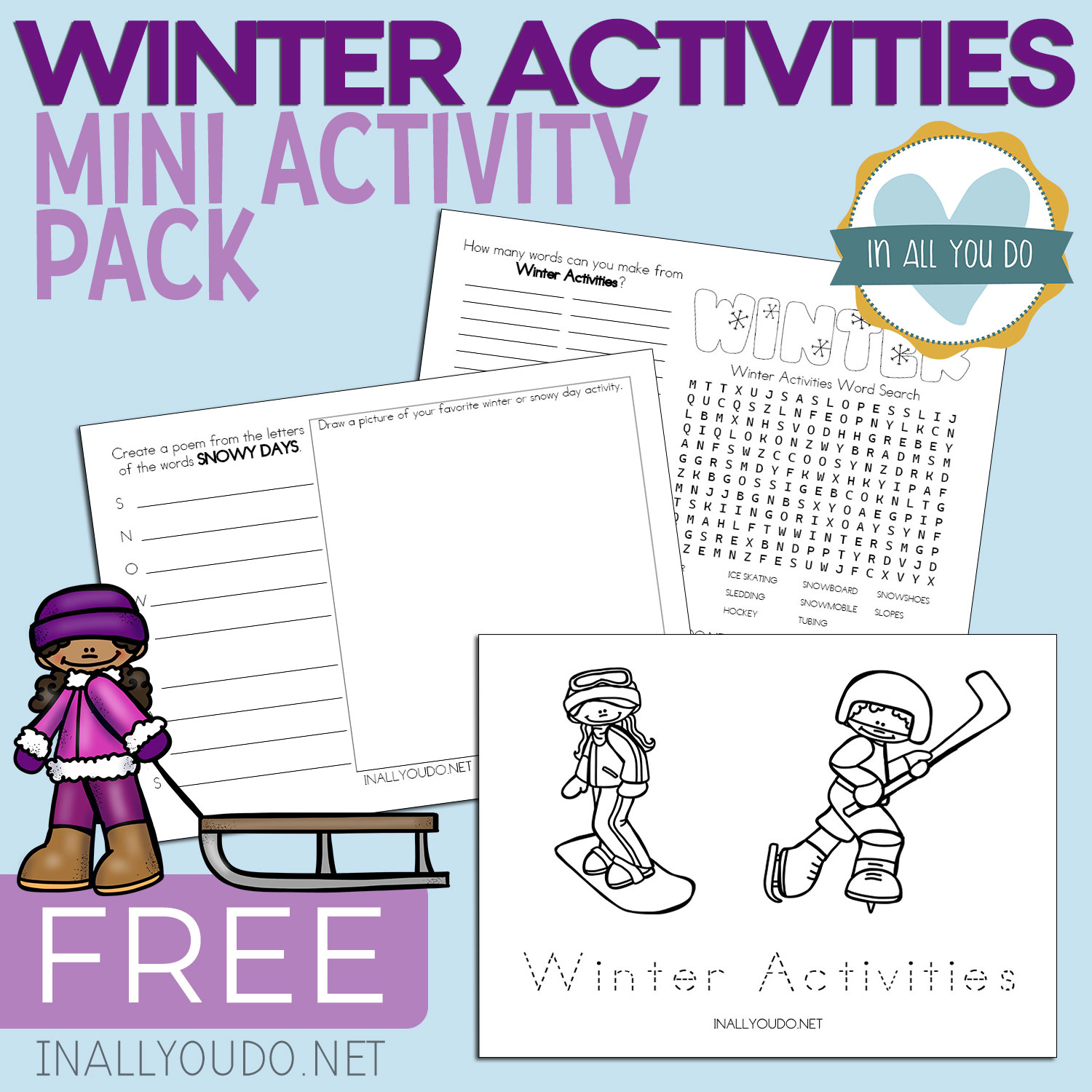
Whether you’re looking to have a printable coloring page on hand for snow days, or you just love winter activities, our mini activity pack is a fun addition to any winter unit. The Winter Activities Mini Activity Pack includes two free coloring pages, one word search, and two other word activities kids are sure to enjoy.
More Winter Themed Resources

|
|

|

|

|

|
|

|

|
|



 Annette lived many years as an exhausted wife of 1 and mother of 6. Grab your fuzzy blanket, pour your favorite drink, and browse through our encouraging tips, printables, and curriculum options. Read more about me and the ministry here at In All You Do