
Is it possible for children to sit quietly and pay attention to the sermon on Sunday mornings? What if there are not flashy visual aids and entertaining games included with the lesson? Yes, it is! But how?

Scripture is the Word of God and applicable to everyone – even little children. Jesus said, “Let the little children come.” So he obviously wanted them to be in the midst of His teaching.
The best way to teach our children good habits is to model them, allowing them to see us practicing those good habits ourselves. Sitting still and listening during a church service is one of those habits they can learn from being by our side, and it helps when we provide opportunity and tools for them to hone these skills.
We have eight children. All of them learned to sit quietly (for the most part) at a fairly young age. One trick we used was to teach them how to take notes. Even the preschoolers. They saw Mom and Dad taking notes during Bible class and sermons, so taking notes was a normal part of our Sunday morning.
Have a Church Bag
To equip them, each child had a ‘church’ bag in which they kept a notebook, a pencil to write with and a few colored pencils (or crayons) to be used only when we attended services and Bible study. They each added their own little Bible and I often allowed them to include a favorite quiet toy. That’s it.
Let them Copy Your Notes
As the lesson of the day started, I would list out key words from the scriptures we were studying. Or I would list the names of the people and places from our lesson. For children who knew how to write their alphabet, I would have them copy these words, even if they could not yet read them. Just seeing the letters and words soon reinforced them in their brains. It also kept their little hands busy, which was a very good thing.
Draw the story
For the preschoolers I would draw stick figures on a page of their notebooks to illustrate the story or topic. Maybe I’d draw a picture to illustrate a certain character quality (i.e. forgiveness or love.) The children would then copy and/or draw their own version. They loved embellishing what Mom already drew – many times they created a drawing that was even better than Mom’s!
Because the words and drawings were related directly to the lesson, to the words they were hearing as they worked in their notebooks, the two activities reinforced one another — they wrote/illustrated/saw what they heard and vice verse. Their brains were busy connecting pathways between auditory, visual and kinesthetic channels all at the same time.
You can use spiral notebooks or journals or day planners. Lined practice paper for handwriting works well, or just plain notebook paper. I recommend binding these loose pages in a 3-prong folder.
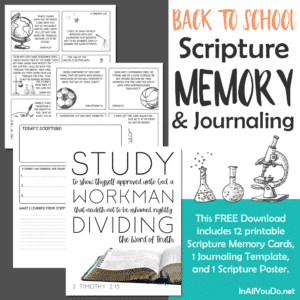
I’ve created a couple of printables to help give guidelines for what to listen for. It’s helpful for me as well as the children to know what information might be important. They love to fill in their ‘worksheets’ and show them off on the way home.
Teach them to take notes or draw pictures that illustrate the words and stories they are hearing. Consider taking notes yourself, it’ll give you a place to start as you discuss the Sunday morning sermon later in the day or week. You can grab your own set of free printables today.

Subscribe now to download
 Linda Sears is a stay-at-home wife, homeschooling mom and doting grandmother. She and her husband have 8 children, a daughter-in-law, 2 sons-in-law and 7 grandchildren, so far. They have been homeschooling for more than 20 years, graduating 4 of their 8 children, with 4 more to go. You’ll find her at Apron Strings & other things where she shares tidbits, tales, tricks and tips from her days of raising children in various stages of cutting those apron strings. You can also find her on FaceBook, Pinterest, and Google+



 Annette lived many years as an exhausted wife of 1 and mother of 6. Grab your fuzzy blanket, pour your favorite drink, and browse through our encouraging tips, printables, and curriculum options. Read more about me and the ministry here at In All You Do