

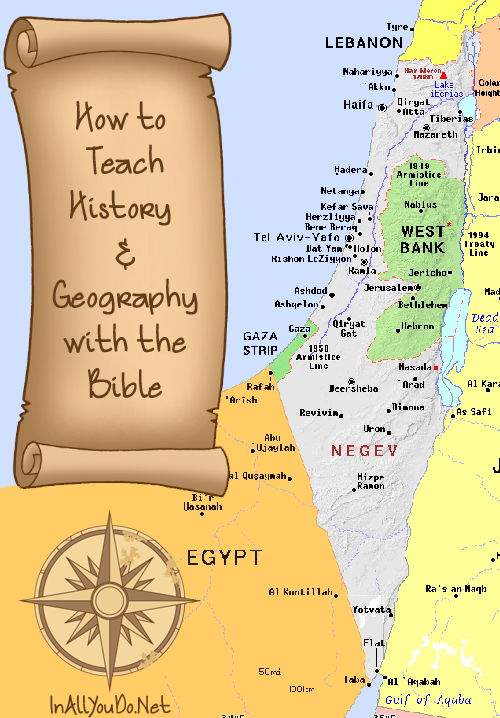
What comes to mind first when you hear someone mention “the Sea of Galilee”? If you’re like me, my thoughts go to Jesus’ ministry in the Gospels. But did you know the Sea of Galilee is mentioned in the Old Testament? In several places, including Numbers 34:11 and Joshua 12:3, the Sea of Galilee is an important landmark.
The idea of standing in the very spot where history happened has always intrigued me. Living in the northeastern part of the United States, I’ve had the opportunity to connect in that way with events that happened hundreds of years ago. But recorded history in the land of Israel goes much further back in time. A journey through Scripture can trace the recorded history of a town or a location back thousands of years. Discovering the history of some of these places can teach students a lot about history and geography, as well as many spiritual truths. Let me show you an example.
First, you will need a good Bible concordance, a Bible dictionary, and a list of Biblical towns (either from a resource such as a cyclopedic concordance or a search on the Internet). You may also want to print these free Biblical history notebooking pages to record your findings. For this example, I’m going to choose Bethel.
From my concordance, I discover that the city of Bethel first appears in Genesis 12*. Looking up the reference in the Bible, I find the story of Abram’s journey. In verse 8, I read, “From there he went on toward the hills east of Bethel and pitched his tent, with Bethel on the west and Ai on the east. There he built an altar to the Lord and called on the name of the Lord.” Bethel is mentioned several more times in Genesis 12 and 13 and then appears again in Genesis 28. Isaac has blessed Jacob and sent him to find a wife. Along the way, Jacob stopped for the night.
“When he reached a certain place, he stopped for the night because the sun had set. Taking one of the stones there, he put it under his head and lay down to sleep. He had a dream in which he saw a stairway resting on the earth, with its top reaching to heaven, and the angels of God were ascending and descending on it. There above it stood the Lord, and he said: ‘I am the Lord, the God of your father Abraham and the God of Isaac. I will give you and your descendants the land on which you are lying. Your descendants will be like the dust of the earth, and you will spread out to the west and to the east, to the north and to the south. All peoples on earth will be blessed through you and your offspring. I am with you and will watch over you wherever you go, and I will bring you back to this land. I will not leave you until I have done what I have promised you.’
“When Jacob awoke from his sleep, he thought, ‘Surely the Lord is in this place, and I was not aware of it.’ He was afraid and said, ‘How awesome is this place! This is none other than the house of God; this is the gate of heaven.’
“Early the next morning Jacob took the stone he had placed under his head and set it up as a pillar and poured oil on top of it. He called that place Bethel, though the city used to be called Luz.
“Then Jacob made a vow, saying, ‘If God will be with me and will watch over me on this journey I am taking and will give me food to eat and clothes to wear so that I return safely to my father’s household, then the Lord will be my God and this stone that I have set up as a pillar will be God’s house, and of all that you give me I will give you a tenth.’” Genesis 28:11-22
It is in this place that God extends His covenant to Jacob. Jacob renames the place Bethel, or “house of God,” and continues on his way. In Genesis 35, Jacob safely returned to Bethel as God had promised. The city appears many more times throughout the Old Testament, but when it appears in I Kings, something extremely dishonoring to God is taking place.
“After seeking advice, the king made two golden calves. He said to the people, ‘It is too much for you to go up to Jerusalem. Here are your gods, Israel, who brought you up out of Egypt.’ One he set up in Bethel, and the other in Dan. And this thing became a sin; the people came to worship the one at Bethel and went as far as Dan to worship the other.” I Kings 12:28-30
In the very place named the “house of God,” the people have set up idols and are worshipping them instead of God. How could so much happen in one place? And is the worship of God ever restored in Bethel?
Searching for the answer can lead students deeper into the Word of God and through history, and it can bring once dry maps to life. Encourage them to take the journey and see what they find.
There is no need to stop with Bethel. Many places in the Bible are mentioned more than once. Here are just a few:
- Damascus
- Bethlehem
- Galilee (the region and the sea)
- Jerusalem
- Dan
- Beersheba
- Carmel
- Dead Sea
- Gilgal
And there is no need to stop with towns and seas. Don’t forget the numerous countries mentioned in the Bible such as Syria, Egypt, Lebanon, and more.
Encourage your older students to make a list of locations to investigate. Have them look up each reference, locate the place on a map, and record what they discover about each. Don’t let them stop with just recording the reference and bare facts about the location. Help them see the value in reading the context of the verses and recording their thoughts about that as well. Some locations will be hard to find on modern maps, so maps of ancient Israel will also help. This also provides the opportunity to find out what ancient cities are called today and discover where they fit in our modern world.
Sometimes, tracing a place name through the Bible can be confusing because of the same place having more than one name. For example, the Sea of Galilee is also referred to as the “Sea of Chinneroth,” the “Lake of Gennesaret,” and the “Sea of Tiberias.” A good Bible dictionary can help students find the various names to look up in a concordance. There are also sometimes more than one location with the same name, so a dictionary can help eliminate confusion there as well.
By combining a study of history and geography with the Bible, we not only learn facts about an important region of the world, we also have the chance to see the Bible come alive in a fresh, new way. Suddenly, these events are not simply locations mentioned in isolated verses but part of the living tapestry of God’s Word.
*All Scripture quotations are taken from the Holy Bible, New International Version®, NIV® Copyright ©1973, 1978, 1984, 2011 by Biblica, Inc.® Used by permission. All rights reserved worldwide.
Did you miss a post in our 30 Days of Bible series? Check them all out by clicking the image below.


Bonnie Rose Hudson works with both SchoolhouseTeachers.com and The Old Schoolhouse Magazine® as a curriculum creator and as the Executive Editor of SchoolhouseTeachers.com. Her heart’s desire is for every child to feel the love of God and know how special they are to Him. She would love for you to stop by her author’s blog WriteBonnieRose.com for resources to help teach your children about missions and the persecuted Church, free history and writing printables, and to discover how you can write for the homeschool market.



 Annette lived many years as an exhausted wife of 1 and mother of 6. Grab your fuzzy blanket, pour your favorite drink, and browse through our encouraging tips, printables, and curriculum options. Read more about me and the ministry here at In All You Do
This Post Has 2 Comments
Thanks for this resource! I love it and look forward to implementing it.
You are so welcome! I hope you enjoy it and it works well for you!